Are you spending your hard-won budget on management training with limited return? This
could be why…
Developing Leaders for the Future
Are you still managing your organisation for the Industrial Revolution? Old school management
approaches which reinforced the infallibility of the leader and consideration for everyone’s
position in the hierarchy developed at a time when work was routine and repetitive, and people
were viewed as no more than dispensable cogs in a well-oiled machine. Fast-forward to the
current day, when the nature and pace of change is volatile, uncertain, complex and
ambiguous, a focus on agility has to be the foundation for leading in a knowledge economy.
Organisations that don’t adapt quickly to political, economic, social and technological
advances and challenges struggle to maintain resilience and momentum. Leaders who
develop themselves and are developed by their organisations can help to build agility, but if
your organisational culture is still stuck in the last century, benefits from development will be
stifled.
Three key elements of leadership and cultural focus have emerged in the recent literature and
research – particularly when working through turbulent times:
• Psychological Safety
• Inclusivity
• Emotional Intelligence
These are separate but interconnected concepts that play a crucial role in fostering a positive
and productive working environment. Whilst each is often centred individually or in a pairing in
learning, our view is that management and leadership development need to focus on
developing all three areas simultaneously to develop a culture that facilitates success. Let’s
look at what the research tells us about the importance of each of these areas for business
performance.
Psychological Safety
We’ve all heard of Maslow’s hierarchy of needs – according to a recent McKinsey report (What
is Psychological Safety? McKinsey, 2023) social scientists now believe that psychological
safety is one of these basic needs. The term was coined by Harvard Professor Amy Edmonson
in 1999 and describes an environment in which there is a shared belief that it’s safe to take
interpersonal risks, such as speaking up, asking questions, challenging the status quo or
admitting mistakes, without fear of negative consequences. Research by MFHA in partnership
with Henley Business School (People Management, March 2025) found that workplace
psychological safety is in decline; employees feel less secure than they did five years ago.
The term really entered the popular lexicon thanks to Google’s research in the mid 2010s on
what di]erentiated their great teams from the good. Known as Project Aristotle, their internal
research pointed to particular norms that are vital to success. There were other behaviours
that seemed important as well — like making sure teams had clear goals and creating a culture
of dependability. But Google’s data indicated that psychological safety, more than anything
else, was critical to making a team work.Returning to McKinsey’s report, they say:
“In extensive research ranging from medical teams in hospitals to software development
teams at Big Tech firms, psychological safety is consistently one of the strongest predictors of
team performance, productivity, quality, safety, creativity, and innovation. It’s also predictive of
better overall health outcomes, as confirmed by social psychologists and neuroscientists.”
Emotional Intelligence
David Goleman’s seminal work “Emotional Intelligence – Why it can matter more than IQ” was
a game changer in terms of Leadership expectations. Fundamentally, Emotional Intelligence is
about understanding and managing our own emotions and seeking to understand and
influence others’. Over the last 30 years, Emotional Intelligence has gone in and out of fashion
and our understanding of how our emotions work and develop has increased significantly
thanks to advances in neuroscience. It’s now recognised that Emotional Intelligence can be
developed and has a significant impact at work – for leaders and for the people that they lead.
Quoted in the white paper “The Impact of Emotional Intelligence in the Workplace” (PSI
Services, 2019) The Denning Centre for Quality Management found that 50% of time in
business is wasted due to a lack of trust between employees. A vital part of the leadership role
is to create an environment where leaders can get the best from their people and, again, from
the PSI white paper, a recent European Survey completed by over 10,000 employees identified
‘bad management’ as the biggest barrier to productivity.
The key findings of their literature review for leaders are that Emotional Intelligence links
strongly to the requirements of agile leadership, the Emotional Intelligence of leaders has a
significant influence on their team members’ job satisfaction and the climate or emotional
tone that leaders set for others is correlated to their levels of Emotional Intelligence.
Inclusivity
Equality, Diversity and Inclusivity are often used interchangeably – or misunderstood. Equality
is about ensuring that everyone has equal opportunity, and no one is discriminated against.
Diversity is about celebrating di]erence, for example, personality, work styles, interests,
culture, experiences. Inclusion is the measure of organisational culture that allows diversity to
thrive – it’s when people feel a sense of belonging and that their perspective is valued.
McKinsey’s “Diversity Matters Even More” report (2023) is founded in studies of 1265
companies, 23 countries and six global regions. Their research highlights that companies with
diverse leadership teams are associated with higher financial returns across industries and
regions. Furthermore, greater diversity in boards and executive teams, in both gender and
ethnicity, is robustly correlated with higher social and environmental impact.
Bourke and Dillon (Deloitte Review, 2018) highlighted that diversity without inclusion is worth
less than when the two are combined; diversity plus inclusion equals better business results.
Deloitte’s research shows that the behaviours of leaders can drive up to 70 percentage points
of di]erence between the proportion of employees who feel highly included and those who
don’t; and an increase in feelings of inclusion translates into an increase in perceived team
performance, decision-making quality and collaboration. Their case for an inclusive culture,rooted in their research is that organisations with an inclusive culture are three times as likely
to be high performing and six times as likely to be more innovative and agile.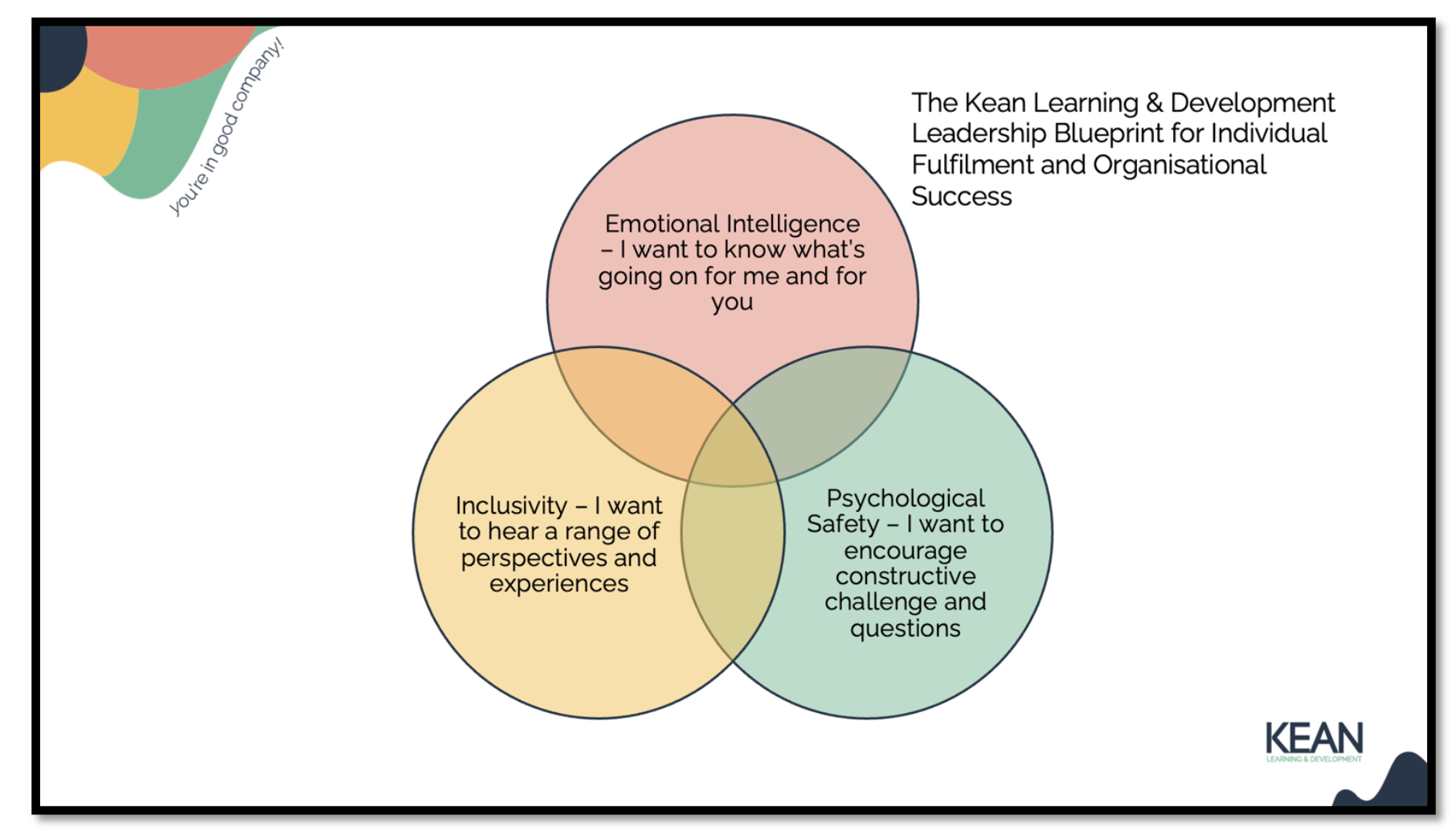
So What?
We’ve been facilitating management and leadership development programmes for decades.
We know that our approach works to build individual knowledge, understanding and
behavioural change. But we also know from experience that there are organisational and
cultural blockers to success. The kind of challenge that can stymy individual development and
frustrate the embedding of learning. That’s why we’ve developed a programme to address
those cultural barriers to successful leadership.
This is a three-module programme on Creating a Culture for Success. It takes leaders on an
immersive and reflective journey designed to raise understanding, breed confidence and
change behaviours and cultural norms. We explore topics such as active listening, developing
a growth mindset culture, learning from failure, harnessing conflict, mindfulness and the
neuroscience of heuristics. It’s rooted in the latest research and best practice and made
bespoke for your organisation to reflect your values and strategic priorities. That sweet spot at
the centre of the Venn diagram is where exciting things happen – innovation, productivity,
agility and wellbeing.
When we don’t have that cultural focus on psychological safety, inclusivity and emotional
intelligence, bad stu] can happen; we might miss out on the best hires, our sta] might become
demotivated, people don’t speak up with their ideas, people try to hide their mistakes, or stress
goes through the roof.
Where would you rather work?