There’s a moment in almost every meeting where something genuinely useful happens.
A decision gets made.
An idea sparks.
Someone volunteers to take ownership.
And then… the meeting ends.
Fast forward a few hours (or days), and suddenly:
- No one’s quite sure what was decided
- Action items are a little fuzzy
- Someone says, “Wait, I thought you were handling that?”
Sound familiar?
The truth is, meetings aren’t the problem.
The way we capture (or don’t capture) them is.
The Hidden Cost of “I’ll Just Take Notes”
Most teams still rely on someone to manually document meetings. And while that sounds reasonable in theory, in practice it creates a few problems:
- The note-taker can’t fully participate
- Important details get missed or misinterpreted
- Notes are inconsistent (or never shared at all)
- Action items get buried in paragraphs no one revisits
It’s not just inefficient—it’s risky. Decisions slip through the cracks, accountability weakens, and momentum slows down.
What If You Never Had to Take Notes Again?
This is where the AI Notetaker inside monday.com changes the game.
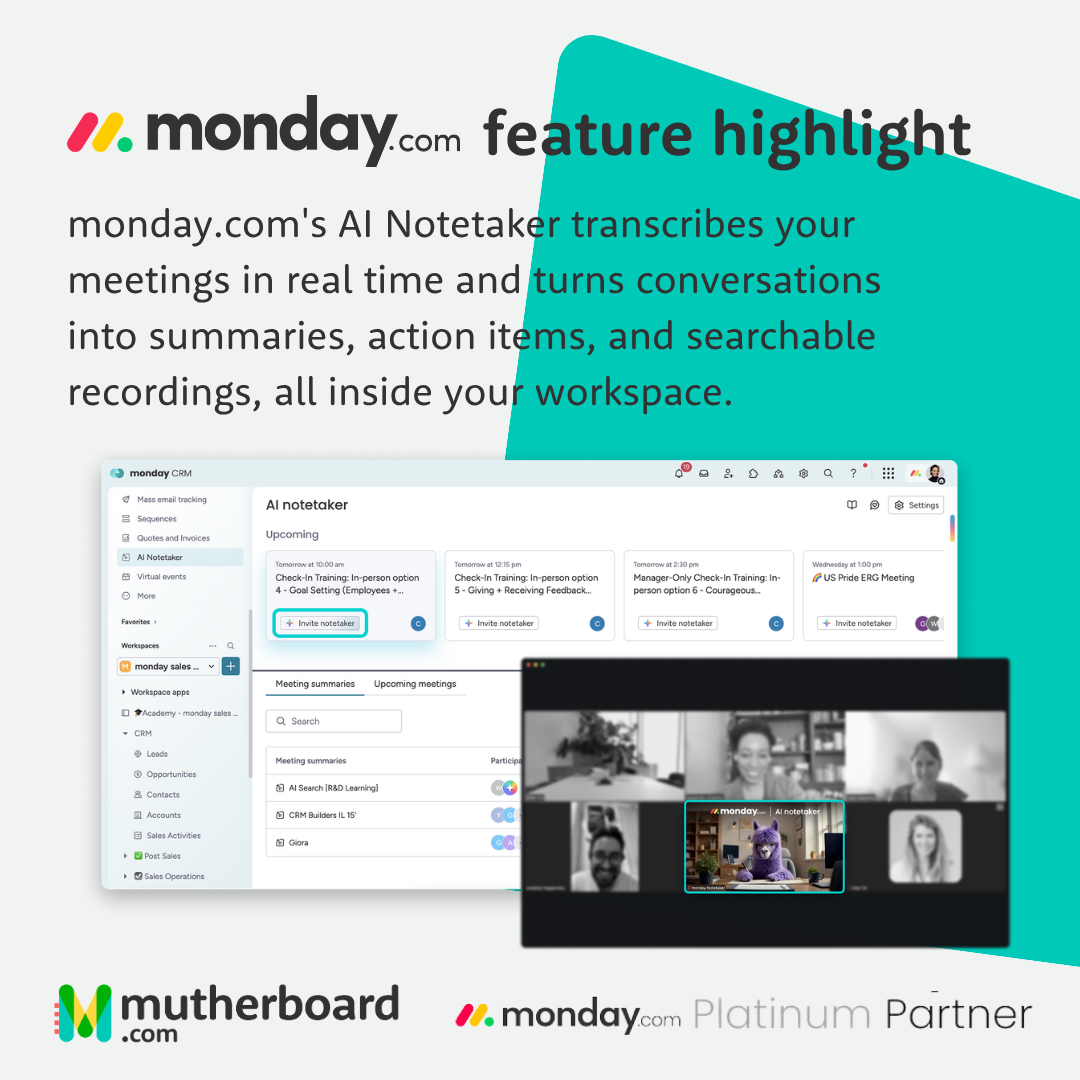
Instead of relying on someone in the room to capture everything, the AI Notetaker does it for you—automatically and in real time.
While your team focuses on the conversation, it’s quietly:
- Transcribing the meeting as it happens
- Pulling out key points and decisions
- Generating clear summaries
- Identifying action items
- Storing everything in your workspace for easy access later
No scrambling. No second-guessing. No “can someone send notes?”
Just clarity.
From Conversations to Action
Here’s where things get interesting.
Most tools stop at transcription. But raw transcripts aren’t actually that helpful—no one has time to reread an entire conversation just to find one decision.
What makes this different is how it transforms conversations into something usable.
Instead of a wall of text, you get:
- Structured summaries you can scan in seconds
- Clearly defined next steps
- Searchable records you can revisit anytime
It turns meetings from something you attend into something that actually moves work forward.
Fewer Meetings About Meetings
Let’s be honest—how many follow-up meetings exist purely because the first one wasn’t captured properly?
“Quick sync to clarify.”
“Just aligning on what we said.”
“Let’s confirm next steps.”
When your meetings are documented clearly the first time, those extra layers start to disappear.
And that’s where the real value shows up:
- Less repetition
- Faster execution
- Stronger accountability across teams
The Bigger Picture: Protecting Your Team’s Time
Your best people aren’t overloaded because they’re doing too little.
They’re overloaded because too much of their time is spent on things that shouldn’t require their energy—like rewriting notes, chasing clarity, or reconstructing decisions.
Taking notes might feel small, but across a week, a month, a year… it adds up.
Automating that process isn’t just a convenience—it’s a shift in how your team works.
It gives people back the space to:
- Think more clearly
- Contribute more meaningfully in meetings
- Focus on execution instead of admin
So, What Would Change for Your Team?
Imagine this:
Every meeting ends with:
- Clear decisions
- Assigned action items
- A summary everyone can access instantly
No delays. No confusion. No loose ends.
That’s the difference between meetings that feel productive… and meetings that actually are.
If your team is ready to spend less time documenting work and more time doing it, this is worth exploring.
👉 Curious how it could fit into your workflow? Let’s talk.