There is a strange contradiction at the heart of project management.
We have more tools, more data and more ways to track our work than ever before. Yet project managers are still spending valuable time pulling information together, formatting reports and trying to turn scattered data into something useful.
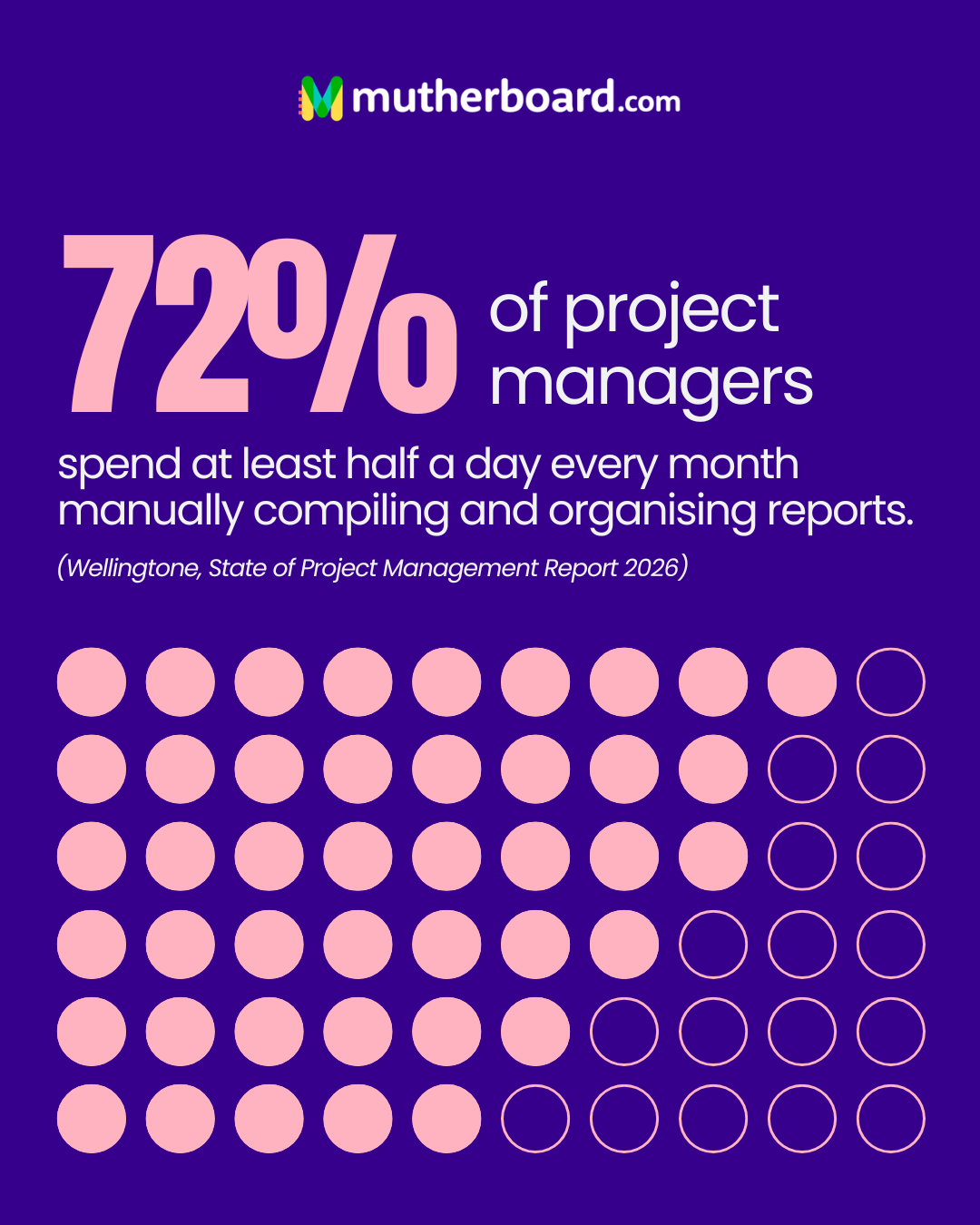
According to Wellingtone’s State of Project Management Report 2026, 72% of project professionals spend half a day or more every month manually collating reports.
Half a day might not sound like much.
Until you multiply it across every month, every project and every project manager.
Then suddenly, that "little bit of admin" becomes a sizeable chunk of time that could have been spent solving problems, supporting teams, managing risks or actually moving projects forward.
The reporting problem is bigger than reporting
Manual reporting is rarely just about creating a report.
First, someone needs to collect the information. Then they need to check whether the data is up to date. Then they need to pull it from different systems, spreadsheets or project boards. Then comes the formatting, the sense checking and the inevitable question:
"Why doesn't this number match the one in the other spreadsheet?"
And somewhere along the way, the project manager becomes less of a project manager and more of a human data integration platform.
That is a problem.
Wellingtone's research highlights a wider challenge across the industry. Only 36% of organisations report that they always or mostly complete projects on time, while 44% are somewhat or very dissatisfied with their current level of project management maturity.
There is clearly work to do when it comes to improving how organisations manage projects.
But perhaps some of that improvement starts with looking at the systems surrounding our project teams.
More data does not automatically mean more visibility
Most organisations do not have a data shortage.
They have a visibility problem.
The information exists. It is just sitting in different places.
Project updates might live in one platform. Resource information might live somewhere else. Financial data could be hiding in a spreadsheet. Customer information might be sitting in a CRM. And someone, somewhere, is probably maintaining a very important spreadsheet that everyone is slightly afraid to touch.
The result is a lot of information, but not necessarily a clear picture of what is actually happening.
That is where integrations can make a huge difference.
When your systems can communicate with each other, information can move automatically instead of relying on someone to copy and paste it. When reporting is automated, project managers can spend less time gathering data and more time interpreting it.
And that distinction matters.
Good project management is not about producing more reports. It is about having the right information at the right time to make better decisions.
What could your project managers do with that time?
Imagine getting half a day back every month.
You could use it to spot a project drifting off schedule before it becomes a crisis.
You could have a more useful conversation with a team member who is overloaded.
You could review resource allocation.
You could investigate a project that is quietly burning through budget.
You could improve a process that everyone has been complaining about for six months.
Or, wild idea, you could simply give your project managers some time to breathe.
The goal of automation should not be to make people work faster so they can fit even more work into their day.
It should be to remove unnecessary work altogether.
The future of project management is connected
Wellingtone's 2026 report is a useful reminder that project management maturity is not just about having a methodology or buying another shiny tool.
It is about creating systems and processes that actually help people deliver better projects. The report looks at areas including project management maturity, tools and techniques, project success rates and PMO effectiveness, drawing on contributions from hundreds of industry professionals.
And one of the clearest takeaways is that there is still plenty of opportunity to improve.
For organisations already juggling multiple platforms, projects and teams, that improvement may start with asking a simple question:
How much of our project management process still depends on humans moving information between systems?
If the answer is "quite a lot", there is probably an opportunity waiting there.
Because your project managers should be managing projects.
Not spending half a day every month playing spreadsheet detective. 🕵️♀️